AI Citation Tracking Vs Brand Monitoring for brand teams
A useful comparison article should make the buying decision clearer without pretending every team needs the same tool. This piece focuses on deciding whether citations or mentions matter more, uses citation-to-mention ratio as the working metric, and includes prompts, FAQs, citations, and implementation checks.
AI Citation Tracking Vs Brand Monitoring is not a winner-take-all choice. The right option depends on what the team needs to prove: citations, mentions, prompt coverage, crawler access, or executive reporting. For brand teams, the cleanest decision starts with citation-to-mention ratio.
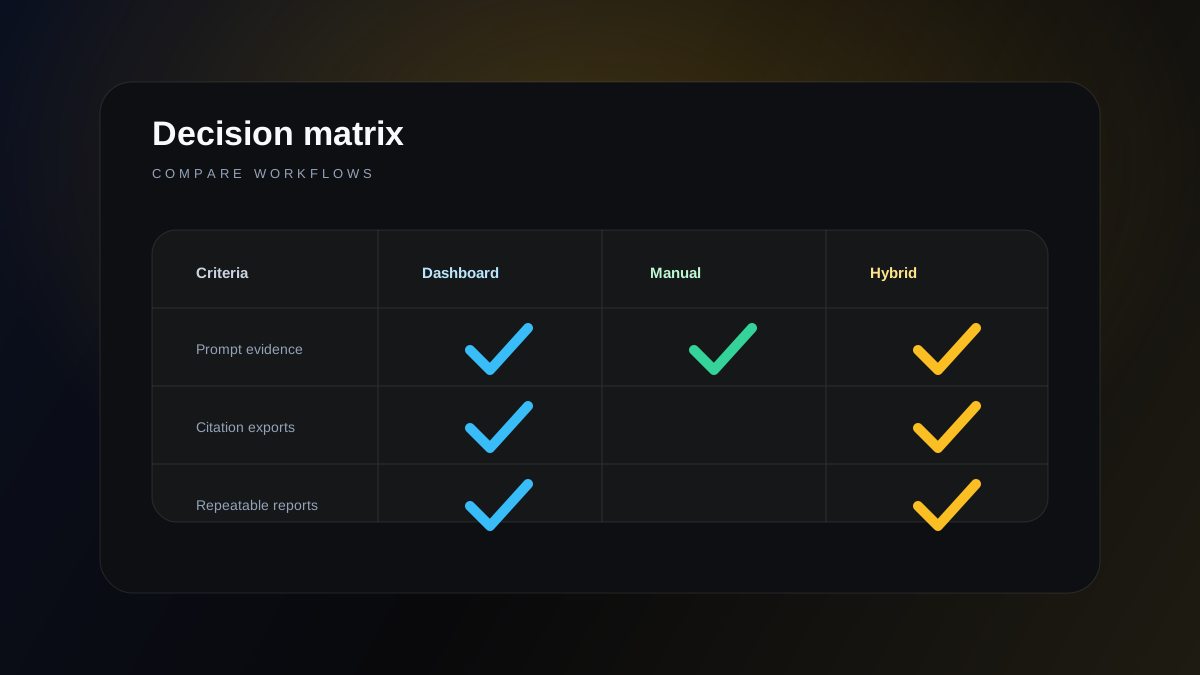
Comparison content should reduce anxiety, show trade-offs, and help a buyer make a specific next move. This article treats AI citation tracking vs brand monitoring as a practical AI visibility topic for brand teams. The goal is to help a reader understand deciding whether citations or mentions matter more, then turn that understanding into crawlable content, structured data, prompt monitoring, and a reporting habit that survives beyond a launch week.
The core point is simple: AI search visibility is not only a content problem. It is a retrieval problem, a clarity problem, and a measurement problem. If brand teams want AI citation tracking vs brand monitoring to work, they need pages that answer clearly, sources that support claims, crawler access that is not blocked, and a way to watch citation-to-mention ratio over time.
If brand teams cannot connect an AI answer back to prompts, citations, and a next content action, the visibility metric is only a screenshot with nicer formatting.
Field note
The decision frame
AI citation tracking vs brand monitoring should be evaluated by the job the buyer needs done. Some teams need keyword rank reporting, some need AI answer evidence, some need crawler diagnostics, and some need content briefs.
For brand teams, the best starting point is citation-to-mention ratio. If a tool or workflow cannot improve that metric or explain why it changed, it may not fit the job.
- Anchor the section in AI citation tracking vs brand monitoring, not generic AI search advice.
- Use citation-to-mention ratio as the measurement thread through the article.
- Give brand teams a next action they can complete this week.
- Support important claims with a source, prompt, example, or internal link.
Where option A is stronger
The first side of the comparison is usually stronger when the team already knows the surface, metric, or workflow it wants. Narrow tools can be faster to adopt and easier to explain.
That said, narrow tools can miss surrounding evidence. A prompt result without source URLs, competitor context, and content actions can leave the team with data but no direction.
- Choose the narrower option when the team has one clear measurement problem.
- Check whether it stores evidence or only shows a summary score.
- Make sure the workflow explains why citation-to-mention ratio changed.
- Confirm the export or reporting format works for the team that will use it.
Where option B is stronger
The second side is usually stronger when the team needs a broader operating system. Multi-surface visibility, prompt clusters, citation evidence, and reporting help teams coordinate work across SEO, content, brand, and leadership.
The trade-off is focus. Broader workflows require a cleaner setup and a disciplined prompt portfolio so the team does not drown in noisy observations.
- Choose the broader option when multiple teams need the same answer evidence.
- Look for prompt clusters, citations, competitors, and content actions in one view.
- Budget setup time for brand facts, competitors, source lists, and prompt grouping.
- Keep the workflow focused so broad coverage does not become noisy reporting.
Questions to ask before buying
Ask which platforms are measured, whether repeated sampling is supported, how citations are stored, how competitors are handled, whether exports are available, and whether the tool can connect findings to content actions.
Also ask what the product will not measure. Honest limitations are a trust signal in a category where many claims are still new.
- Ask what decision this article helps the reader make next.
- Link to related pages only when the next topic genuinely reduces confusion.
- Use the answer, FAQ, and checklist to restate the recommendation in different useful formats.
- Review AI citation tracking vs brand monitoring again after real prompt data starts coming in.
Best-fit recommendation
Choose the workflow that matches the decision you need to make this month. If the question is "are we cited?", prioritize citation tracking. If the question is "what should we publish?", prioritize gap analysis and briefs.
If the question is "how do we run AI visibility as a program?", prioritize a platform that connects prompts, sources, competitors, reports, and citation-to-mention ratio.
- Ask what decision this article helps the reader make next.
- Link to related pages only when the next topic genuinely reduces confusion.
- Use the answer, FAQ, and checklist to restate the recommendation in different useful formats.
- Review AI citation tracking vs brand monitoring again after real prompt data starts coming in.
Research signals to watch
Signal 1Google's AI content guidance emphasizes accuracy, quality, relevance, and useful metadata. That makes AI citation tracking vs brand monitoring stronger when the page has a direct answer, descriptive title, clear headings, and visible supporting detail.
Signal 2Google's scaled content abuse policy warns against many low-value pages made mainly to manipulate rankings. This article avoids that pattern by giving brand teams a specific angle, metric, prompts, FAQs, and source links.
Signal 3Bing's 2026 AI Performance preview calls out citations, grounding queries, page-level citation activity, clarity, FAQs, and evidence. Those ideas map directly to citation-to-mention ratio.
Signal 4Schema.org and Google both support BlogPosting and breadcrumb structured data for editorial pages, so this page includes article, FAQ, and breadcrumb JSON-LD rather than relying on visible text alone.
Prompts to test
Implementation checklist
- 1Write the direct answer for AI citation tracking vs brand monitoring in the first screen of the article.
- 2Add BlogPosting, FAQPage, and BreadcrumbList JSON-LD that matches visible content.
- 3Link to related tools, solutions, learn, glossary, features, and compare pages where the reader naturally needs context.
- 4Run prompts that mention brand teams, competitors, use cases, and buying objections.
- 5Record citation-to-mention ratio, cited URLs, answer sentiment, and competitor mentions after each monitoring run.
- 6Refresh the article only when facts, examples, source evidence, or product workflow materially improve.
Frequently asked questions
What is AI citation tracking vs brand monitoring?
AI Citation Tracking Vs Brand Monitoring is not a winner-take-all choice. The right option depends on what the team needs to prove: citations, mentions, prompt coverage, crawler access, or executive reporting. For brand teams, the cleanest decision starts with citation-to-mention ratio.
How should brand teams measure AI citation tracking vs brand monitoring?
Start with citation-to-mention ratio, then add cited URLs, answer accuracy, competitor mentions, and source quality. The goal is not a single perfect number; it is a repeatable view of whether AI answers are getting clearer and more favorable over time.
Does AI citation tracking vs brand monitoring replace traditional SEO?
No. Traditional SEO foundations still matter because AI systems often rely on crawlable, well-structured, trusted web content. AI Citation Tracking Vs Brand Monitoring adds the answer layer: prompts, citations, recommendations, and AI-specific visibility evidence.
How often should this page be updated?
Update it when the facts, product workflow, platform behavior, citations, or examples change. Changing the date without a meaningful content improvement is not useful for readers or search systems.
Sources cited
- Google Search Central: guidance on generative AI contentUsed for the accuracy, quality, relevance, and scaled-content guardrails behind this article.
- Google Search Central: scaled content abuse policyUsed to keep this library focused on useful, topic-specific pages instead of doorway-style scale.
- Google Search Central: Article structured dataUsed for BlogPosting markup, author/date fields, and validation expectations.
- Bing Webmaster Blog: AI Performance in Bing Webmaster ToolsUsed for the GEO focus on citations, grounding queries, page-level citation activity, clarity, FAQs, and evidence.
Related blog articles