AI Share Of Voice for CMOs
A useful glossary article should define the term, then show the reader how to measure and apply it. This piece focuses on a competitive visibility metric for AI answers, uses competitive mention share as the working metric, and includes prompts, FAQs, citations, and implementation checks.
AI Share Of Voice means a competitive visibility metric for AI answers. In AI search work, the useful definition is operational: can a team measure it, improve it, and connect it to a cited answer or recommendation? For CMOs, the first metric to watch is competitive mention share.
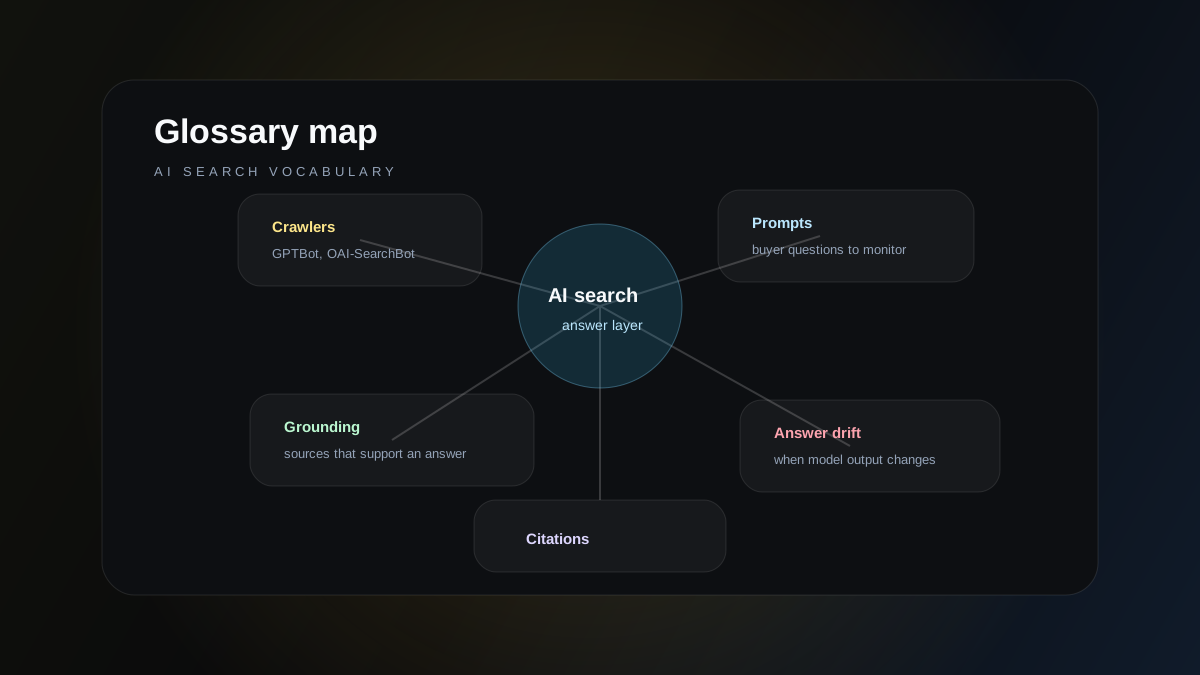
Glossary content is strongest when the definition is short, but the surrounding examples make the term usable. This article treats AI share of voice as a practical AI visibility topic for CMOs. The goal is to help a reader understand a competitive visibility metric for AI answers, then turn that understanding into crawlable content, structured data, prompt monitoring, and a reporting habit that survives beyond a launch week.
The core point is simple: AI search visibility is not only a content problem. It is a retrieval problem, a clarity problem, and a measurement problem. If CMOs want AI share of voice to work, they need pages that answer clearly, sources that support claims, crawler access that is not blocked, and a way to watch competitive mention share over time.
If CMOs cannot connect an AI answer back to prompts, citations, and a next content action, the visibility metric is only a screenshot with nicer formatting.
Field note
Definition
AI Share Of Voice is a competitive visibility metric for AI answers. The term matters because AI search work needs a shared vocabulary before teams can measure, improve, or report it.
For CMOs, the shortest useful definition is the one tied to behavior: what changes on the page, what changes in the answer, and what changes in competitive mention share.
- Define competitive mention share before choosing tools, content, or reporting views.
- Show the visible evidence: prompt text, answer excerpt, cited URL, and platform.
- Separate a brand mention from a recommendation, citation, and sentiment change.
- Keep the definition specific enough for CMOs to act on it.
Why it matters
AI search has made old SEO language feel incomplete. A blue-link rank can still matter, but it does not explain whether an assistant mentions the brand, cites the page, or recommends a competitor.
AI share of voice helps teams name the missing layer. Once the term is clear, the team can assign ownership and decide which pages, sources, and prompts deserve attention.
- Anchor the section in AI share of voice, not generic AI search advice.
- Use competitive mention share as the measurement thread through the article.
- Give CMOs a next action they can complete this week.
- Support important claims with a source, prompt, example, or internal link.
Example in practice
Imagine a buyer asks an assistant for a shortlist, a comparison, or a definition. The answer may pull from owned pages, review sites, documentation, forums, or publisher content. AI Share Of Voice describes one part of that process.
The practical move is to record the prompt, answer text, cited sources, and follow-up action. That turns the glossary term into operational evidence.
- Anchor the section in AI share of voice, not generic AI search advice.
- Use competitive mention share as the measurement thread through the article.
- Give CMOs a next action they can complete this week.
- Support important claims with a source, prompt, example, or internal link.
How to measure it
The default measurement is competitive mention share, but no single number tells the whole story. Pair the metric with cited URLs, sentiment, answer accuracy, and competitor presence.
A glossary page earns its keep when the reader can leave with both the definition and a way to check whether it is improving.
- Define competitive mention share before choosing tools, content, or reporting views.
- Show the visible evidence: prompt text, answer excerpt, cited URL, and platform.
- Separate a brand mention from a recommendation, citation, and sentiment change.
- Keep the definition specific enough for CMOs to act on it.
Research signals to watch
Signal 1Google's AI content guidance emphasizes accuracy, quality, relevance, and useful metadata. That makes AI share of voice stronger when the page has a direct answer, descriptive title, clear headings, and visible supporting detail.
Signal 2Google's scaled content abuse policy warns against many low-value pages made mainly to manipulate rankings. This article avoids that pattern by giving CMOs a specific angle, metric, prompts, FAQs, and source links.
Signal 3Bing's 2026 AI Performance preview calls out citations, grounding queries, page-level citation activity, clarity, FAQs, and evidence. Those ideas map directly to competitive mention share.
Signal 4Schema.org and Google both support BlogPosting and breadcrumb structured data for editorial pages, so this page includes article, FAQ, and breadcrumb JSON-LD rather than relying on visible text alone.
Prompts to test
Implementation checklist
- 1Write the direct answer for AI share of voice in the first screen of the article.
- 2Add BlogPosting, FAQPage, and BreadcrumbList JSON-LD that matches visible content.
- 3Link to related tools, solutions, learn, glossary, features, and compare pages where the reader naturally needs context.
- 4Run prompts that mention CMOs, competitors, use cases, and buying objections.
- 5Record competitive mention share, cited URLs, answer sentiment, and competitor mentions after each monitoring run.
- 6Refresh the article only when facts, examples, source evidence, or product workflow materially improve.
Frequently asked questions
What is AI share of voice?
AI Share Of Voice means a competitive visibility metric for AI answers. In AI search work, the useful definition is operational: can a team measure it, improve it, and connect it to a cited answer or recommendation? For CMOs, the first metric to watch is competitive mention share.
How should CMOs measure AI share of voice?
Start with competitive mention share, then add cited URLs, answer accuracy, competitor mentions, and source quality. The goal is not a single perfect number; it is a repeatable view of whether AI answers are getting clearer and more favorable over time.
Does AI share of voice replace traditional SEO?
No. Traditional SEO foundations still matter because AI systems often rely on crawlable, well-structured, trusted web content. AI Share Of Voice adds the answer layer: prompts, citations, recommendations, and AI-specific visibility evidence.
How often should this page be updated?
Update it when the facts, product workflow, platform behavior, citations, or examples change. Changing the date without a meaningful content improvement is not useful for readers or search systems.
Sources cited
- Google Search Central: guidance on generative AI contentUsed for the accuracy, quality, relevance, and scaled-content guardrails behind this article.
- Google Search Central: scaled content abuse policyUsed to keep this library focused on useful, topic-specific pages instead of doorway-style scale.
- Google Search Central: Article structured dataUsed for BlogPosting markup, author/date fields, and validation expectations.
- Bing Webmaster Blog: AI Performance in Bing Webmaster ToolsUsed for the GEO focus on citations, grounding queries, page-level citation activity, clarity, FAQs, and evidence.
- Schema.org: BlogPostingUsed for the editorial schema type applied to the page.
Related blog articles