How To Monitor AI Answer Drift for brand teams
A useful learning article should make the concept usable in one sitting and leave the reader with a working checklist. This piece focuses on detecting when answer language or sentiment changes, uses answer drift rate as the working metric, and includes prompts, FAQs, citations, and implementation checks.
How To Monitor AI Answer Drift helps brand teams with detecting when answer language or sentiment changes. The page should not stop at definitions: it needs a measurable workflow, examples of prompts to test, source evidence, internal links, and a repeatable answer drift rate reporting loop.
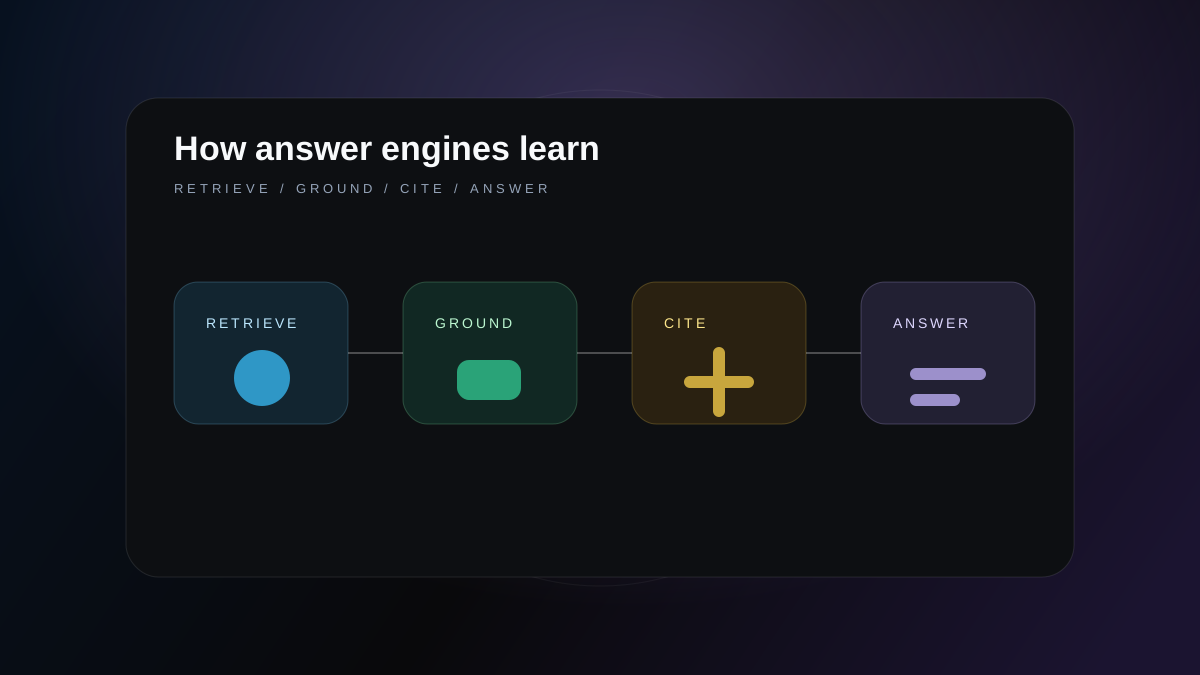
Learning content works when it slows the concept down enough for a marketer to use it the same afternoon. This article treats How to monitor AI answer drift as a practical AI visibility topic for brand teams. The goal is to help a reader understand detecting when answer language or sentiment changes, then turn that understanding into crawlable content, structured data, prompt monitoring, and a reporting habit that survives beyond a launch week.
The core point is simple: AI search visibility is not only a content problem. It is a retrieval problem, a clarity problem, and a measurement problem. If brand teams want How to monitor AI answer drift to work, they need pages that answer clearly, sources that support claims, crawler access that is not blocked, and a way to watch answer drift rate over time.
If brand teams cannot connect an AI answer back to prompts, citations, and a next content action, the visibility metric is only a screenshot with nicer formatting.
Field note
The plain-English model
How to monitor AI answer drift is easiest to understand as a retrieval and answer problem. A user asks a question, an AI system gathers sources or relies on indexed knowledge, and the final answer chooses which entities and pages deserve mention.
For brand teams, the practical question is not "how do we trick the model?" It is "what public evidence would make us the clear and useful answer?"
- Anchor the section in How to monitor AI answer drift, not generic AI search advice.
- Use answer drift rate as the measurement thread through the article.
- Give brand teams a next action they can complete this week.
- Support important claims with a source, prompt, example, or internal link.
What to do first
Start with ten real buyer prompts, not a giant keyword export. Run them across the surfaces that matter, record whether the brand appears, and note the pages or sources that are cited.
Then inspect the missing prompts. Most gaps trace back to weak definitions, missing comparisons, thin proof, confusing site structure, blocked crawler access, or no page that answers the question directly.
- Anchor the section in How to monitor AI answer drift, not generic AI search advice.
- Use answer drift rate as the measurement thread through the article.
- Give brand teams a next action they can complete this week.
- Support important claims with a source, prompt, example, or internal link.
How to write the page
Use an answer-first introduction, then support the answer with detail, examples, and sources. Put the primary keyword in the H1 naturally, but do not repeat it until the page feels machine-written.
Short paragraphs, descriptive H2s, FAQs, schema, and internal links make the article easier for people to scan and easier for AI systems to extract.
- Prioritize direct answers, proof, examples, and internal links over keyword repetition.
- Use cited sources and visible FAQs where they help the reader verify the claim.
- Watch whether competitors are used as sources even when they are not recommended.
- Turn missing answer evidence into a specific page update or new article brief.
How to measure progress
Track answer drift rate over a stable prompt set. The same prompt should be tested repeatedly so the team can see directional movement instead of reacting to a single volatile answer.
Pair the metric with qualitative notes: Was the answer accurate? Was an owned page cited? Did a competitor gain a citation? Did the answer use the category language the team wants?
- Define answer drift rate before choosing tools, content, or reporting views.
- Show the visible evidence: prompt text, answer excerpt, cited URL, and platform.
- Separate a brand mention from a recommendation, citation, and sentiment change.
- Keep the definition specific enough for brand teams to act on it.
How to keep it useful
Refresh pages when the facts change or the page can become more helpful. Do not change dates just to look fresh, and do not add pages only because a spreadsheet says the site needs more volume.
The best learning content becomes a reference: it is clear enough for a beginner, specific enough for an operator, and sourced enough for an AI answer to trust.
- Do not publish near-duplicate pages just because the keyword list is large.
- Do not refresh dates unless the article, data, examples, or source evidence changed.
- Do not use unsupported claims in a page meant to be cited by answer engines.
- Do not ignore crawler policy, schema validity, or source quality when visibility drops.
Research signals to watch
Signal 1Google's AI content guidance emphasizes accuracy, quality, relevance, and useful metadata. That makes How to monitor AI answer drift stronger when the page has a direct answer, descriptive title, clear headings, and visible supporting detail.
Signal 2Google's scaled content abuse policy warns against many low-value pages made mainly to manipulate rankings. This article avoids that pattern by giving brand teams a specific angle, metric, prompts, FAQs, and source links.
Signal 3Bing's 2026 AI Performance preview calls out citations, grounding queries, page-level citation activity, clarity, FAQs, and evidence. Those ideas map directly to answer drift rate.
Signal 4Schema.org and Google both support BlogPosting and breadcrumb structured data for editorial pages, so this page includes article, FAQ, and breadcrumb JSON-LD rather than relying on visible text alone.
Prompts to test
Implementation checklist
- 1Write the direct answer for How to monitor AI answer drift in the first screen of the article.
- 2Add BlogPosting, FAQPage, and BreadcrumbList JSON-LD that matches visible content.
- 3Link to related tools, solutions, learn, glossary, features, and compare pages where the reader naturally needs context.
- 4Run prompts that mention brand teams, competitors, use cases, and buying objections.
- 5Record answer drift rate, cited URLs, answer sentiment, and competitor mentions after each monitoring run.
- 6Refresh the article only when facts, examples, source evidence, or product workflow materially improve.
Frequently asked questions
What is How to monitor AI answer drift?
How To Monitor AI Answer Drift helps brand teams with detecting when answer language or sentiment changes. The page should not stop at definitions: it needs a measurable workflow, examples of prompts to test, source evidence, internal links, and a repeatable answer drift rate reporting loop.
How should brand teams measure How to monitor AI answer drift?
Start with answer drift rate, then add cited URLs, answer accuracy, competitor mentions, and source quality. The goal is not a single perfect number; it is a repeatable view of whether AI answers are getting clearer and more favorable over time.
Does How to monitor AI answer drift replace traditional SEO?
No. Traditional SEO foundations still matter because AI systems often rely on crawlable, well-structured, trusted web content. How To Monitor AI Answer Drift adds the answer layer: prompts, citations, recommendations, and AI-specific visibility evidence.
How often should this page be updated?
Update it when the facts, product workflow, platform behavior, citations, or examples change. Changing the date without a meaningful content improvement is not useful for readers or search systems.
Sources cited
- Google Search Central: guidance on generative AI contentUsed for the accuracy, quality, relevance, and scaled-content guardrails behind this article.
- Google Search Central: scaled content abuse policyUsed to keep this library focused on useful, topic-specific pages instead of doorway-style scale.
- Google Search Central: Article structured dataUsed for BlogPosting markup, author/date fields, and validation expectations.
- Bing Webmaster Blog: AI Performance in Bing Webmaster ToolsUsed for the GEO focus on citations, grounding queries, page-level citation activity, clarity, FAQs, and evidence.
- Schema.org: BlogPostingUsed for the editorial schema type applied to the page.
Related blog articles